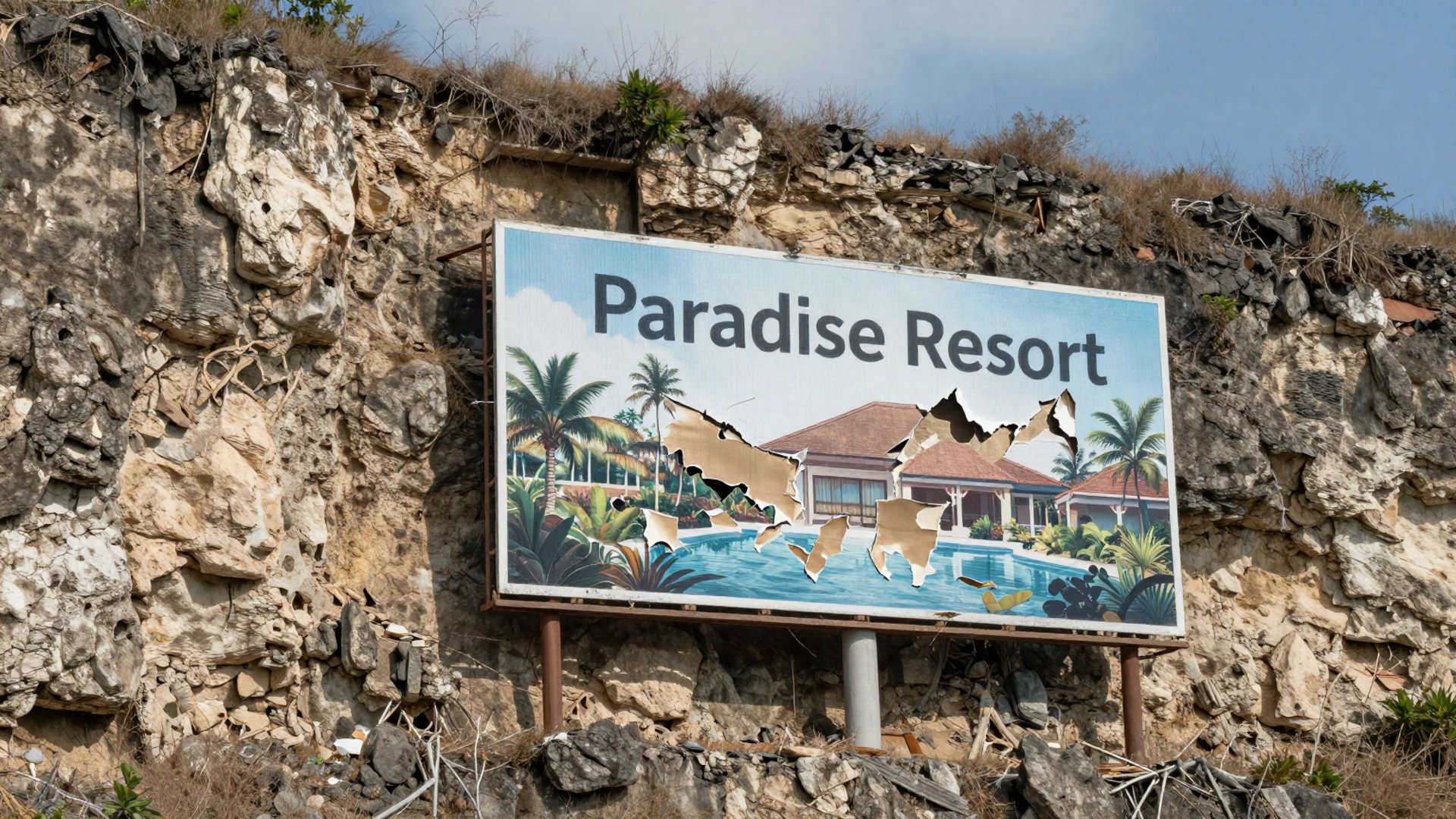
How "Paradise Resort" Became a Monument to Legal Negligence
The skeletal remains of what was once marketed as the "Paradise Resort" now stand as a grim landmark in the lush hills of Karangasem, serving as a stark reminder that even the most ambitious visions can crumble without a solid legal foundation. This multi-million dollar project, envisioned as a world-class eco-luxury destination, ground to a halt mid-construction when a series of surprise inspections revealed that the developers had jumped the gun. While the marketing team was already selling "pre-construction" units to global investors, the construction crews were clearing land without a valid Persetujuan Bangunan Gedung (PBG) and had completely ignored the regional spatial planning maps (RTRW). The Paradise Resort case became a local scandal when it was discovered that the project encroached upon a protected green belt zone, leading to an immediate and permanent "stop-work" order from the Bali Provincial Government. Today, the site is a "mangkrak" (stagnant) monument to the dangers of ignoring the rule of law in favor of rapid expansion, with millions of dollars in investment now locked in a legal stalemate.
The collapse of Paradise Resort highlights the absolute necessity of securing comprehensive legality before moving a single pile of earth in Bali. In the current 2026 regulatory landscape, governed heavily by the Law No. 6 of 2023 (Job Creation Law), the "build first, ask later" mentality is a recipe for financial suicide. Every developer is now required to obtain a Business Identification Number (NIB) through the Risk-Based Online Single Submission (OSS) system. As of early 2026, the system has become even more integrated; per the latest updates to SIMBG v3.2, building approvals are now linked in real-time to the KKPR (Kesesuaian Kegiatan Pemanfaatan Ruang). This means that if a project's coordinates overlap with a restricted zone—like a green belt or a sacred site—the system will automatically reject the application. For Paradise Resort, attempting to bypass this digital gate resulted not just in a fine, but in a total operational freeze that has left their investors empty-handed.
Beyond the buildings themselves, running a successful resort in Bali requires a deep, legally-binding respect for the island’s natural resources and cultural heritage. The Law No. 17 of 2019 regarding Water Resources mandates that any commercial entity must have a SIPA (Surat Izin Pengambilan Air Tanah) to prevent the depletion of local aquifers. In the case of Paradise Resort, the lack of an approved environmental impact assessment (AMDAL or UKL-UPL) meant they never accounted for how their massive water consumption would affect neighboring rice fields, leading to fierce legal opposition from local Subak communities. Furthermore, new 2026 enforcement milestones require all hospitality listings on digital platforms to be cross-verified against their SLF (Sertifikat Laik Fungsi). Without this "Certificate of Worthiness," a resort is effectively banned from the market. This case study teaches us that legal compliance isn't just a bureaucratic hurdle; it is the only way to ensure that a "Paradise" on paper doesn't become a nightmare in reality.
Navigating Bali’s 2026 Development Laws
For any entrepreneur or investor, understanding the "Legality First" framework in Bali is the difference between a thriving business and a "mangkrak" ruin. Here are the critical pillars you must know:
Risk-Based Licensing (OSS-RBA): Under PP No. 5 of 2021, your business is categorized by its risk level. Resorts are typically "High Risk," meaning you cannot operate with just an NIB; you must undergo a full verification of your technical standards, including environmental and safety audits.
The PBG and SLF Duo: The old IMB is dead. Today, you need a Persetujuan Bangunan Gedung (PBG) to start building and a Sertifikat Laik Fungsi (SLF) to open your doors. Starting construction without a PBG can lead to administrative fines of up to 10% of the building's value or even a demolition order under PP No. 16 of 2021.
Zoning and KKPR Integration: In 2026, zoning is enforced via real-time GIS data. Under Bali Provincial Regulation No. 2 of 2023, strict administrative sanctions are applied to any spatial violation. If the KKPR (Spatial Agreement) doesn't match your business activity (KBLI), your project is legally void.
Environmental & Water Compliance: To protect Bali’s ecosystem, Law No. 17 of 2019 (Water Resources) and Presidential Regulation No. 51 of 2016 (River and Coastal Buffers) are now strictly enforced. Paving over a river buffer or drilling an illegal well will result in immediate sealing by the BWS (Bali-Penida River Basin Center).
The Golden Rule: Always ensure your PT PMA (Foreign Investment Company) or local entity has a "Verified" status in the OSS system before signing any land lease or starting design work. In Bali, true luxury starts with a clean legal slate.
#BaliRealEstate2026 #BaliInvestment #PTPMA #InvestInBali #IndonesiaPropertyLaw #BaliVillaInvestment #BaliPropertyAnalysis #IndonesiaRealEstate #BaliBusinessSetup #HakGunaBangunan #BaliROI #UluwatuRealEstate #CangguProperty #BaliLegalAdvice #BaliPropertyMarket #ForeignInvestmentIndonesia #BaliLandForSale #BaliSubway #BaliMRT #SangkaraDewataAsia #BaliZoning #InvestSmartBali #BaliSustainableLiving #BaliSmartHomes #IndonesiaOmnibusLaw #BaliPBG #BaliBusinessLegal #BaliExpatInvestment #BaliLuxuryVillas #BaliInfrastructure2026